Podcast Appearances
AI and the Future of Education
The Authority Podcast: Conversations with Experts
September 11, 2023
Related Projects
- AI & The Future of Education: Teaching in the Age of Artificial Intelligence
Transcript
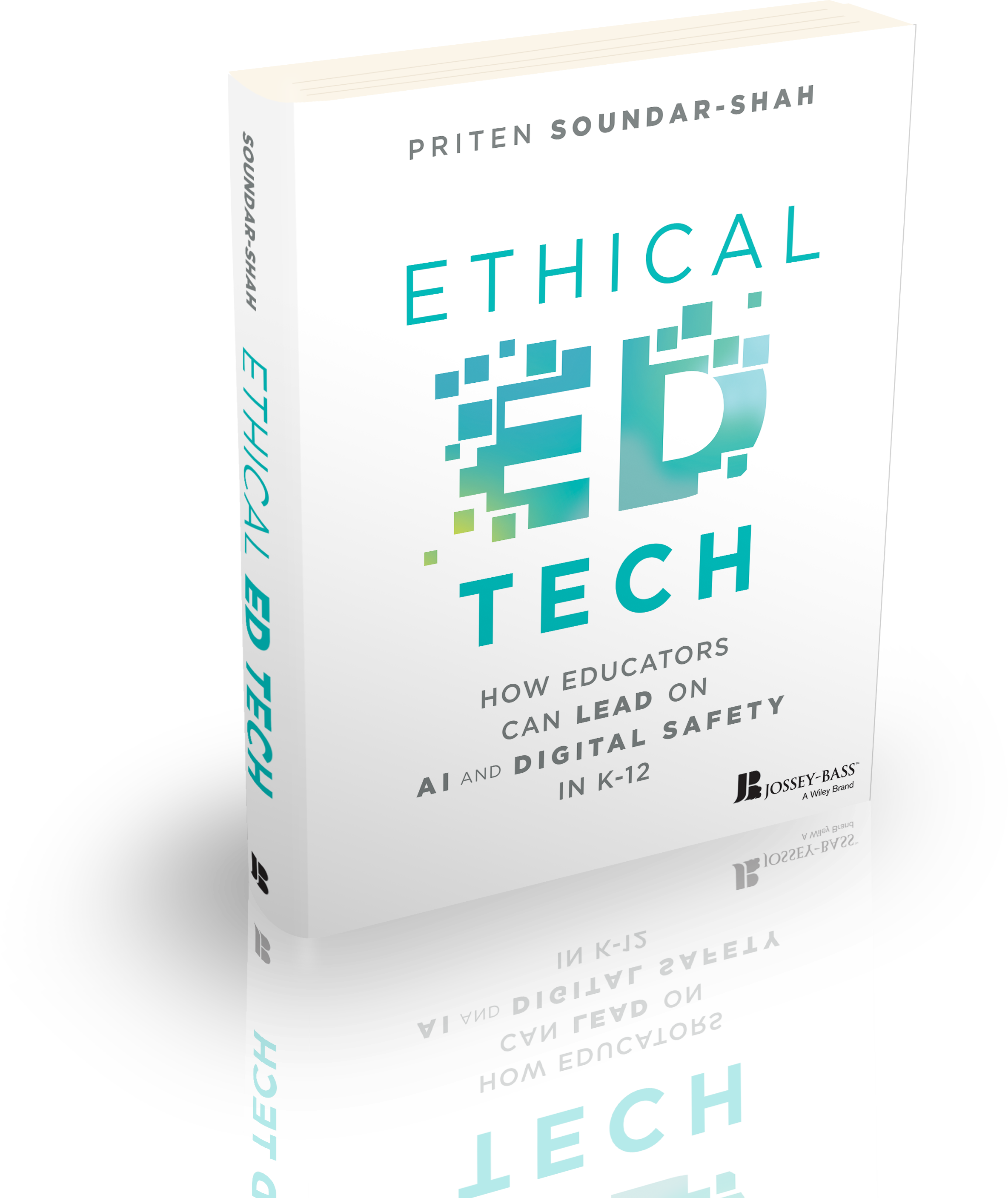
Ross Romano: AI, artificial intelligence. Sometimes it can seem like all anyone talks about nowadays, but if you've been listening to the Summer of AI series on Transformative Principal, for example, you know how important it is that we really do discuss AI thoughtfully, understand what it means for the future of education. And for our students, for the economy, right? And everything that's happening in our schools, preparing our students for that future. So today I'm really pleased to bring you a guest who has much to say on this topic. He has a brand new book out on it. Priten Shah is the CEO of Pedagogy.cloud, which provides innovative technology solutions to help educators navigate global challenges in a rapidly evolving world. He's also the founder of civics education nonprofit United for Social Change, and he's author of the book we're discussing today, which is called AI and the Future of Education: Teaching in the Age of Artificial Intelligence. Priten, welcome to the show.
Priten Shah: Thanks, Ross. Thanks for having me.
Ross Romano: So, one of the things among teachers in particular, but a lot of people in a lot of different lines of work and part of society — there's a lot of rumors, confusion, fear around the rise of AI, certainly over the past year or so. It seems like all of a sudden it's everywhere. And even though the concepts of artificial intelligence and machine learning have been around for quite a while, it's become inescapable. And I think the more inescapable something is, the more some people want to escape it, right? So I thought maybe what we should start with, just to context that for our conversation, is just to get the baseline definitions of AI and how it is different from machine learning and other things, because I think if people understand what AI actually is, it becomes a little bit less scary, right?
Priten Shah: Yeah, absolutely. And AI has become this catch-all term, right? So when people talk about AI, they could be talking about anything from a spam filter to a neural network. And I think the reason why is because in 1956, we had this Dartmouth Conference where a group of scholars got together and said, "Let's try to create intelligent machines." And from that point on, we've been using AI as this umbrella term. So technically speaking, AI is any computer program that exhibits some sort of intelligent behavior. And machine learning is more specific. Machine learning is a subset of AI. And the idea there is that instead of a programmer writing the rules that govern an algorithm or a computer program, instead, they feed the computer algorithm some data, and the computer algorithm learns the patterns from the data, and then applies those patterns to new data. So you're right, that's an important distinction. And in recent months and in recent years, we've had deep learning, which is a subset of machine learning. And deep learning uses something called artificial neural networks. And so all of those terms are related, but they're not the same thing.
Ross Romano: So let's look at those neural networks. How do they work in simple terms, right?
Priten Shah: Sure. In nature, we have biological neural networks, right? That's your brain. Your brain has approximately 86 billion neurons, and you've got these synapses that connect them. And the way the brain learns is through these neural connections. So when you practice something, or you learn something new, these connections get stronger. An artificial neural network is trying to mimic that structure. So you'll have a layer of input nodes. And let me give you an example. I might have a neural network that's trained on images of cats and dogs. So the input nodes would be the pixels from those images. And then I would have these hidden layers in between, and these hidden layers are processing the information that comes in from the input nodes. And then you have an output layer that makes a classification or prediction. So maybe the output layer says, "This is a cat" or "This is a dog."
That's a very simplified explanation because in reality, modern neural networks can have thousands or millions of nodes. And it's often called a "black box" because we don't fully understand how the network arrived at a particular answer, or at a particular classification. But the key idea is that we're iteratively tuning the connections between the neurons to minimize the error. So it's learning from the data.
Ross Romano: I want to ask you a little bit about large language models because that seems like what everyone's talking about right now, especially after ChatGPT came out last year.
Priten Shah: Yeah, absolutely. And ChatGPT really did take the world by storm. And I think it was because it was easy to use, right? You just type a prompt, and you get a response. And I think for many people, it was their first encounter with a neural network or with any kind of AI tool. So large language models are neural networks that are trained on vast amounts of text. ChatGPT was trained on hundreds of billions of words from the internet and books and other text sources. And these large language models are predicting the next word in a sequence based on the previous words. So when you type a prompt into ChatGPT, it's predicting the next word. And then the next word. And then the next word. So it's kind of a statistical model. It doesn't really have common sense or understanding in the way that humans do. It's very much a pattern-matching exercise. And I think that's an important thing to understand.
Ross Romano: So when we talk about this in an educational setting, there's a difference between someone using ChatGPT as a way to cheat, versus using it as a tool for learning, right? Could you speak to that?
Priten Shah: Yeah, absolutely. So I think the way we've been framing AI in education has been a little bit reactionary, right? A lot of schools have been saying, "Oh no, AI is going to ruin writing. Our students are going to use it to cheat." And there are legitimate concerns there, but I think the more exciting opportunity is to think about how we can use AI as a teaching tool. And so if a student uses ChatGPT to write an entire essay, that's cheating, right? But if a student uses it to brainstorm ideas, or to get feedback on their writing, or to help them think through a problem, that's actually a really powerful educational tool.
So think about tutoring, right? If you have one-on-one tutoring, the research shows that it's incredibly effective for student learning. But most students don't have access to a one-on-one tutor. AI can provide that kind of personalized feedback and guidance that a human tutor would provide. And that's a really exciting opportunity for education.
Ross Romano: So you talk about different types of AI applications in education. Is that something we could dive into a little bit?
Priten Shah: Yeah, absolutely. So when I think about AI in education, I think about it across a few different dimensions. One is personalized learning. And the idea there is that each student is different, right? Each student has different learning styles, different pace of learning. And what's powerful about AI is that it can adapt the content and the difficulty of the material based on an individual student's needs. Another application is assessment. Right now, most teachers in most classrooms, they give a test, and the test tells them whether a student knows something or doesn't know something. But with AI, we can have more frequent, more detailed feedback on a student's learning. And the benefit there is that it allows teachers to identify misconceptions or gaps in student learning much faster. And then the third one I want to mention is instructional content. Right now, most instructional content, it's one size fits all. A teacher stands at the front of the classroom, gives the same lecture to all the students. But with AI, we can generate instructional content that is tailored to an individual student's needs.
And then there's administrative efficiency, right? I think one of the things that teachers are complaining about is that there's so much administrative work. And a lot of these administrative tasks can be automated, or assisted with AI. So things like grading, things like lesson planning. So yeah, those are some of the ways that AI can be applied in education.
Ross Romano: It's interesting because in previous episodes, I've talked with people about how much time teachers spend on administrative work. And it's a big issue. It's exhausting for them. If AI could support that, it would be really beneficial. But I also want to go back to something you mentioned about personalized learning. How does that actually work? Can you give us an example or walk us through what that might look like in a classroom setting?
Priten Shah: Yeah, absolutely. So let me give you an example. Imagine you have a group of students learning about fractions. And maybe you have a student who is struggling with the concept, and another student who has already mastered it. In a traditional classroom, the teacher would probably give the same instruction to both students. But with AI, you could have a system that identifies that the student who is struggling needs a different approach. Maybe they need more visual explanations, or maybe they need more examples. And the student who has mastered it, they might be ready to move on to a more complex concept. So the AI system can adapt the content in real time based on the student's learning needs.
Ross Romano: And we have examples of this already, right?
Priten Shah: Yes, absolutely. So there are a lot of ed tech companies that are using AI to personalize learning. One example is adaptive learning platforms. And these are systems that track the student's performance, and then they adapt the difficulty of the material, or the type of content that's presented, based on that performance. And then there are also intelligent tutoring systems. And these are more sophisticated systems that can actually provide feedback to students, similar to how a human tutor would. And then there are also some tools that can generate customized homework problems based on a student's learning needs. So yeah, there are definitely examples of this that exist today.
Ross Romano: So the book is called AI and the Future of Education. And I think when you look at the title, there's this implicit assumption that AI is going to be a big part of the future of education. Where do you see AI being most impactful in education over, let's say, the next three to five years?
Priten Shah: Well, I think the biggest opportunity for AI in education is to address this massive equity problem that exists, right? A student in a well-funded school district has access to great teachers, great resources, and great technology. But a student in an under-resourced school district doesn't have the same resources. And I think AI has the potential to democratize access to high-quality education. And if we can use AI to provide personalized instruction, and tutoring, and feedback to every student, regardless of where they live or how much money their family has, I think that's a huge opportunity. So I think over the next three to five years, I think we're going to see more adoption of adaptive learning platforms. And I think we're going to see more personalized tutoring systems that use AI.
And I think we're also going to see more use of AI in assessment, where you have more continuous feedback for students. And I think we're also going to see more use of AI to assist teachers with administrative tasks. So I think there are a lot of exciting opportunities.
Ross Romano: One of the things that concerns people is that AI might replace teachers. How do you see that?
Priten Shah: Yeah, so I think that's a legitimate concern. And I think it's important to be transparent about the fact that AI is going to change the role of teachers. But I don't think it's going to replace teachers. And I think the reason why is because teaching is more than just transferring information. Teaching is about building relationships with students. It's about inspiring them. It's about developing their character. It's about helping them find their purpose. And I think AI can handle the more routine tasks, like grading and lesson planning. But it can't replace the human relationships and the mentorship that teachers provide.
So I think what's going to happen is that teachers are going to shift more towards being facilitators, or coaches, rather than lecturers. They'll spend less time on routine tasks, and more time on things like providing mentorship, building relationships, and developing student character.
Ross Romano: So that's a really optimistic vision. And I want to ask you, based on what you're seeing in the real world, how close are we to realizing that vision? Is this something that we're seeing already? Or is this something that's years away?
Priten Shah: Yeah. So I think it's happening already, right? There are schools that are using AI-powered adaptive learning systems. There are teachers that are using ChatGPT or other AI tools to assist with lesson planning. There are ed-tech companies that are using AI to personalize learning. So it's definitely happening. And I think with the pace of AI innovation, we're going to see more and more of this in the coming years.
But I think it's important to note that adoption isn't uniform. So there are schools that are ahead of the curve, and there are schools that are behind the curve. But I think gradually, over time, more schools will adopt these technologies.
Ross Romano: So let me ask you about the role of teachers in developing these tools. Do you think teachers should have more of a say in the design of these AI education tools?
Priten Shah: Yeah, absolutely. I think teachers need to be at the table. And I think the reason why is that teachers know what works in the classroom. They know what their students need. And so if you're designing an AI tool without teacher input, you risk building something that's not useful, or that doesn't actually address the real needs of teachers and students.
So I think it's critical that we involve teachers in the design process. And actually, at Pedagogy Cloud, that's something that we do. We have teachers as part of our product development process. And I think that's really important. So yes, I think teachers need to have a bigger voice in the development of these tools.
Ross Romano: So you mentioned Pedagogy Cloud. Tell us a little bit about what you do there.
Priten Shah: Yeah, so Pedagogy Cloud is a platform that provides innovative technology solutions to help educators navigate global challenges. And one of those challenges is the need for instructional design support. So teachers have these great ideas for lessons, but they often lack the expertise or the time to turn those ideas into high-quality instructional content. And so Pedagogy Cloud provides a platform where teachers can use AI to help them with instructional design. A teacher might use our platform to generate lesson plans, or to generate questions for assessment, or to generate other types of instructional content.
And our platform also allows teachers to collaborate with other teachers and share resources. And I think that's really important because teaching can be isolating sometimes. You're in your classroom by yourself. But if you have a community of teachers that you can learn from and collaborate with, I think that that makes you a better teacher. So that's the vision of Pedagogy Cloud.
Ross Romano: And you mentioned a nonprofit organization as well.
Priten Shah: Yeah, so I'm the founder of United for Social Change. And United for Social Change is a nonprofit organization that focuses on civics education. And we believe that civics education is really important because it helps young people understand their role in society, and it helps them become engaged citizens. And in this age of misinformation and polarization, I think civics education is more important than ever.
And so United for Social Change works with schools to help them strengthen their civics education programs. And we also work with teachers to help them better teach civics. And we also develop curriculum and resources for civics education. And we also do teacher training and professional development. So yeah, that's the nonprofit work that I do.
Ross Romano: So you have this unique perspective from being involved in both for-profit education technology, through Pedagogy Cloud, and also nonprofit civics education work through United for Social Change. What do you see as the biggest challenge facing education today?
Priten Shah: Yeah, so I think the biggest challenge is the equity issue that I mentioned earlier. Right? We have this massive gap in resources between well-funded and under-resourced school districts. And that gap translates into a gap in student outcomes. And I think that's the most pressing challenge.
But I also think there are other challenges. One is that we need to rethink what we're teaching. Right? We're still teaching content that was developed decades ago. And the world has changed so much. So I think we need to rethink curriculum, and what skills are actually important for students to learn.
And I also think we need to rethink how we assess student learning. Right now, we rely heavily on standardized tests, and I think those tests are a poor measure of what students actually know. So I think we need to move towards more authentic forms of assessment.
And then I think we also need to support teachers. Right? Teachers are the backbone of education. And yet, they're often under-resourced, under-supported, and under-valued. And so I think if we can support teachers — with tools, with professional development, with better working conditions — I think that's going to make a huge difference.
Ross Romano: So in your book, you talk about what education could be in the age of AI. And I think that's a pretty optimistic vision. But also, there are some real risks and concerns about AI and education. Could you speak to those?
Priten Shah: Yeah, absolutely. So I think one of the biggest risks is bias in AI systems. And the reason why is because AI systems are trained on data. And if that data contains biases, then the AI system will perpetuate or amplify those biases. And so if you have an AI system that's making decisions about student learning, and that system is biased, it could have really negative consequences for students, particularly for marginalized students. So I think it's critical that we're thinking about bias in AI, and we're working to mitigate it.
Another risk is around data privacy. Right? If you're using AI in education, you need to collect a lot of student data. And that student data is really sensitive. It's personal information. And so it's critical that we have strong data privacy protections.
And then there's also the issue of algorithmic transparency. Right? I mentioned that neural networks are often called a "black box." And so if you're using an AI system to make decisions about student learning, it's important that we understand how that system is making decisions.
And then there's also the issue of over-reliance on AI. And I think what I mean by that is that AI is a tool, and it's not a panacea. Right? It can't solve all the problems in education. And so I think it's important that we think about AI as a complement to good teaching, not as a replacement for good teaching.
And then I think there's also the issue of AI replacing human relationships. And that goes back to what I said earlier about teaching being more than transferring information. And so I think it's critical that we use AI in a way that supports human relationships, rather than replacing them.
Ross Romano: So let's talk about bias for a moment, because I think that's something that people are really concerned about. How do we mitigate bias in AI systems?
Priten Shah: Yeah, so I think there are a few different approaches. One approach is to think about the data that you're using to train the AI system. And so if you're trying to mitigate bias, you need to think carefully about the training data. If the training data is biased, then the AI system is likely to be biased. And so one approach is to try to collect training data that's more representative.
Another approach is to use algorithmic techniques to try to mitigate bias. And so there are researchers that are developing techniques that can help reduce bias in AI systems.
And then I think another approach is to have diverse teams working on these systems. And I think the reason why is because if you have a diverse team, they're more likely to identify potential biases that you might otherwise miss.
And then I think it's also important to continuously monitor the performance of these systems. And so if a system is showing signs of bias, you can quickly take action to address it.
Ross Romano: So one thing that I think about, and I suspect listeners do too, is how do I, as a parent or as an educator, help my students, or my children, develop an understanding of AI that's balanced. Right? You don't want them to be Luddites. You don't want them to be afraid of AI. But you also want them to be critical thinkers about AI. How do you recommend we approach that?
Priten Shah: Yeah, so I think it starts with understanding. And so I think it's really important that students understand how AI works. And you don't have to be a computer scientist to understand AI. Right? You just need to understand the basic concepts. And so I think schools should be teaching students about AI, and how it works, and what it can and can't do.
And I think it's also important that students think critically about AI. So for example, students should be thinking about, "How was this AI system trained? What data was it trained on? Are there potential biases? How might this system impact me as an individual or as a society?"
And I think it's also important for students to experiment with AI tools. Maybe the student could use ChatGPT, or some other AI tool, and think about how they might use it responsibly.
And then I think it's important to also teach students about the limitations of AI. And so I think students should understand that AI systems can make mistakes. They can be biased. They can be misused. And so I think it's important that students develop a critical understanding of AI. And I think the way to do that is through education.
Ross Romano: So Priten, I want to ask you, given all the changes coming, how would you sum up the future of education in the age of AI?
Priten Shah: Yeah, so I think the future of education is going to look very different from what it looks like today. I think we're moving away from a one-size-fits-all model of education towards a more personalized model. I think teachers are going to shift more towards being facilitators, or coaches, rather than lecturers.
And I think we're going to see more use of AI to assist students, and teachers, and administrators. And I think that's a really exciting opportunity. Because I think, at its best, education is about helping young people discover their potential, and develop the skills that they need to thrive in the world. And I think AI can be a tool that helps us achieve that goal.
But I think it's also important that we approach AI thoughtfully. Right? We need to think about equity. We need to think about bias. We need to think about data privacy. We need to think about the role of human relationships in education. And I think if we can address those concerns, I think AI is going to have a really positive impact on education. And I think we're going to create an educational system that's more equitable, more personalized, and more effective. So I'm pretty optimistic about the future.
Ross Romano: That's fantastic. Priten, before we close out, I want to make sure people know how they can find out more about you, your book, and your organizations. Can you tell us where people can reach you?
Priten Shah: Yeah, absolutely. So my book is called AI and the Future of Education: Teaching in the Age of Artificial Intelligence. And it's available on Amazon, and through other book retailers. And they can also visit my website, which is pritenshahcom, all one word. And then Pedagogy Cloud, they can find us at pedagogycloud.com. And United for Social Change, they can find us at united4socialchange.org. And then on social media, they can find me on Twitter @pritenshahcom, and on LinkedIn. And I'm always happy to connect with people who are interested in education technology and innovation. So yeah, feel free to reach out.
Ross Romano: That's fantastic, Priten. Thanks so much for taking the time to be with us. This has been a really informative and thoughtful conversation about a topic that's so relevant to all of us.
Priten Shah: Thanks, Ross. Thanks for having me. It was a pleasure.
Ross Romano: Well, that's all the time we have for this week's episode of The Authority. If you enjoyed this conversation with Priten Shah, be sure to check out his book, AI and the Future of Education: Teaching in the Age of Artificial Intelligence. Thanks for listening. And we'll see you next week.
Related conversations

Podcast
Role of AI in the Future of Education
EdInsights
Podcast
The Role of AI in the Future of Education with Priten Shah (EP155)
Rethinking Learning Podcast
Podcast
AI in the Future of Education with Priten Shah
EduMagic New Teacher Podcast
Podcast
The Promise and Dangers of AI in Education
All of the Above